Rabab Fatima, UN Under-Secretary-General and High Representative for the Least Developed Countries, Landlocked Developing Countries and Small Island Developing States
Doha, Qatar: The global push to support the world’s most vulnerable countries in achieving sustainable and irreversible development progress reached a significant milestone this week as policymakers, development partner and international organisations convened in Doha for the High-level Meeting on “Forging Ambitious Global Partnerships for Sustainable and Resilient Graduation of Least Developed Countries (LDCs).”
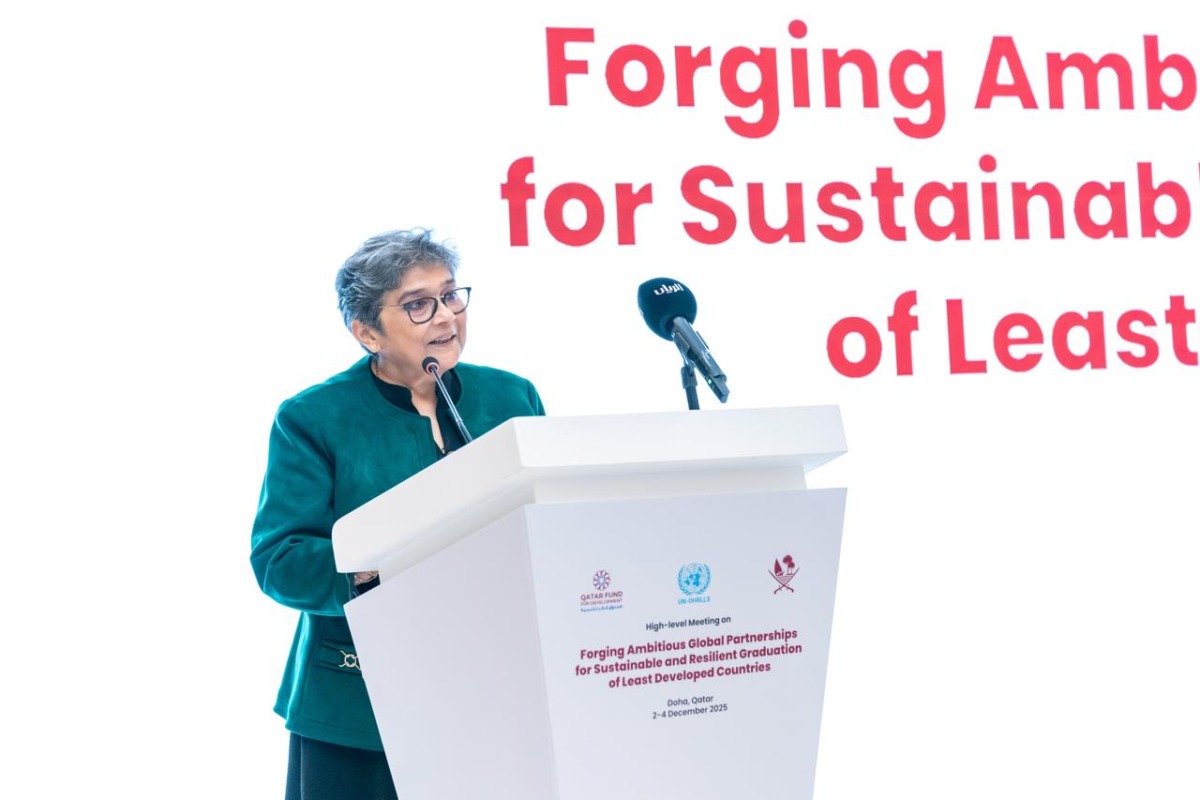
Speaking in an exclusive interview with The Peninsula on the sidelines of the meeting, Rabab Fatima, UN Under-Secretary-General and High Representative for the Least Developed Countries, Landlocked Developing Countries and Small Island Developing States, underscored the event’s “historic significance” and commended Qatar’s leadership in driving implementation of the decade-long Doha Programme of Action (DPoA) adopted during the LDC5 conference in March 2023.
Fatima said the government of Qatar, the Qatar Fund for Development and Qatar’s Permanent Mission to the UN have been “instrumental” in ensuring that the DPoA does not remain a symbolic document but “truly comes to life.”
“Too often, major conferences end with commitments that fade over time,” she noted. “But in this case, because of the generous and consistent support of Qatar, we are seeing real implementation, real progress and real momentum.”
At the heart of the DPoA is one of the most ambitious goals in the history of the UN’s LDC agenda: enabling at least 15 additional countries to graduate from the LDC category by 2031. Graduation marks a major national milestone, signalling that a country has overcome key structural vulnerabilities and met UN-defined thresholds related to income, human assets and environmental and economic resilience.
Momentum has accelerated since the adoption of the DPoA. Only eight countries have graduated from LDC status since the category was created in 1971—Botswana, Cabo Verde, Maldives, Bhutan, São Tomé and Príncipe, Vanuatu, Comoros and Equatorial Guinea. However, an unprecedented, 14 countries are currently in the graduation pipeline, with several at advanced stages.
“Never in the 54-year history of the LDC group have we had so many countries on track,” Fatima said. “And for the first time, we see equal representation of African and Asian LDCs moving toward graduation. This is an important moment.”
Countries such as Bhutan and São Tomé and Príncipe recently graduated, while Bangladesh, Nepal and Lao PDR are scheduled to graduate next year. Yet graduation brings challenges. LDCs benefit from a range of international support measures—including duty-free, quota-free market access, concessional financing, favourable loan terms and waivers under international agreements such as the WTO TRIPS agreement. The abrupt withdrawal of these benefits can jeopardise development gains.
Fatima stressed the need for “smooth, sustainable and irreversible graduation,” explaining that without proper transition mechanisms, countries risk sliding back. “Graduation must be incentivised,” she said. “LDCs should not fear losing support the moment they cross the threshold. The process cannot be abrupt.”
To address this, the UN Office of the High Representative has launched iGrad, the Sustainable Graduation Support Facility, introduced at the LDC5 conference and supported generously by Qatar. The facility provides tailored, country-specific assistance—acknowledging that “no one size fits all”—to help LDCs navigate the complexities of transition.
This week’s meeting in Doha represents graduating and already graduated countries gathered together with development partners to analyse challenges, exchange lessons and build coordinated approaches. Countries such as Bhutan, Maldives and Cabo Verde provided insights into how economic diversification, policy reforms and long-term planning enabled their successful transitions. Development partner countries, including Germany, Finland, Australia and India, also took part, alongside UN bodies such as the DESA, UNIDO, UNIDO and regional economic commissions, as well as WTO.
“This is true global partnership,” Fatima emphasised. “LDCs cannot do it alone. The UN system, partner countries and development actors all play vital roles.”