Dr. Sirajeddin Belkhair, Senior Consultant Neurosurgeon and Director of Neurosciences at DOC Medical Center
In a groundbreaking achievement for Qatar's private healthcare sector, Dr. Sirajeddin Belkhair, Senior Consultant Neurosurgeon and Director of Neurosciences at DOC Medical Center, successfully performed the nation's first navigated spine surgery in a private hospital at View Hospital. Combining cutting-edge computer-assisted navigation with pioneering virtual reality surgical planning, this milestone represents a transformative leap in surgical precision and patient safety for Qatar and the wider GCC region.
When Millimeters Make All the Difference
The spine is unforgiving terrain. Thread a screw one millimeter off course, and you risk nerve damage, paralysis, or the need for revision surgery. Thread it perfectly, and you restore mobility, eliminate pain, and transform a life. For decades, spine surgeons have walked this tightrope between healing and harm, relying on experience, fluoroscopy, and steady hands.
But what if surgeons could see through bone? What if they could rehearse the operation in three dimensions before making a single incision? What if technology could guide every instrument with GPS-like precision?
Dr. Sirajeddin Belkhair, a North American–trained neurosurgeon with decades of pioneering work across continents, recently performed something no surgeon in Qatar's private healthcare sector had achieved before: a fully navigated spine surgery using real-time computer-assisted guidance combined with virtual reality pre-surgical planning.
"For the first time in Qatar, I used virtual reality technology to plan spine screws before surgery," Dr. Belkhair explains. "These electronic glasses showed me 3D images of the patient's CT scan, allowing me to plan screw placement in the perfect position. What I saw in those glasses translated directly into the operating room, visible on screens, guiding every movement."
It wasn't just innovation for innovation's sake. It was precision medicine meeting patient care at the highest level.
The Technology Behind the Breakthrough
Navigated spine surgery combines real-time, three-dimensional imaging with optical or electromagnetic tracking systems that follow surgical instruments as they move through the body. Think of it as GPS for the human spine, mapping instruments within the vertebral anatomy with millimeter-level accuracy.
Dr. Belkhair took this further. Before the patient entered the operating room, he used virtual reality glasses that transformed CT scan data into an immersive, three-dimensional surgical rehearsal space. He could rotate the spine, zoom into pedicles (the narrow bone corridors where screws must pass), measure angles, and plan screw trajectories with unprecedented detail.
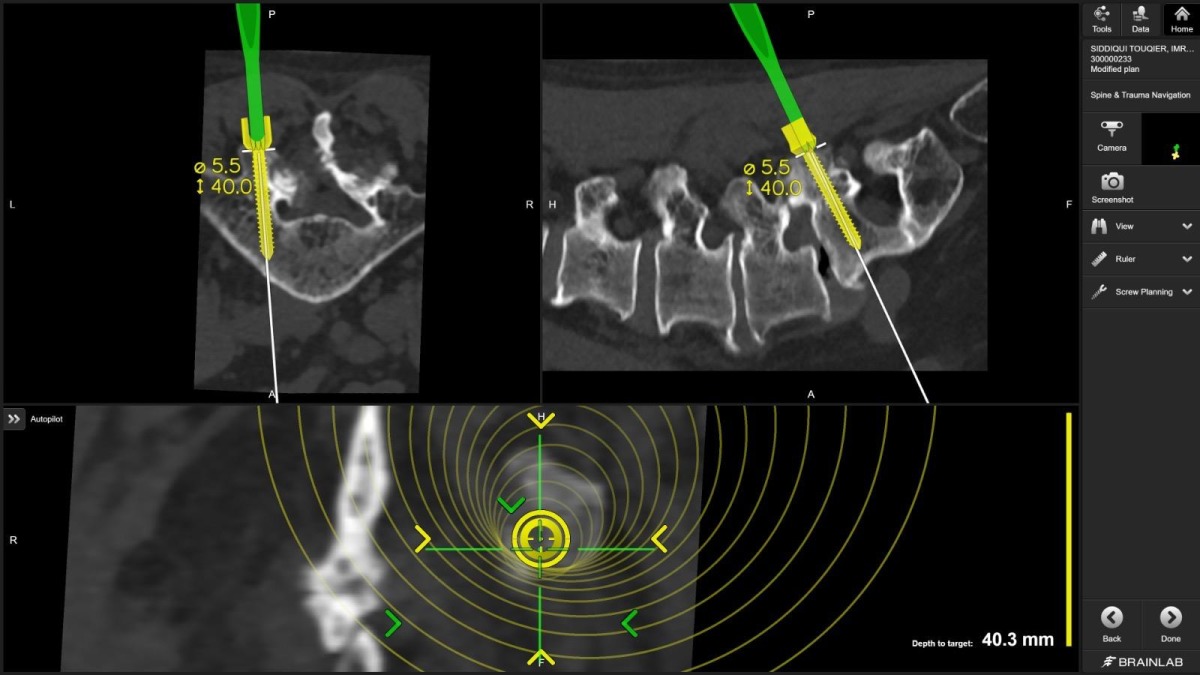
"The planning became the roadmap. The navigation ensured we followed it perfectly," he notes.
According to research published in The Spine Journal, navigated spine surgery demonstrates statistically significant improvements in pedicle screw accuracy, reduced blood loss, shorter hospital stays, fewer screw revisions, and lower systemic complications. Navigated approaches achieve over 95% optimal screw placement rates, a benchmark that directly translates into safer outcomes for patients.
Why This Matters for Qatar and the GCC
The successful navigated spine surgery at View Hospital marks a turning point for Qatar's private healthcare sector. It signals that patients no longer need to travel abroad for the most advanced spine procedures. The expertise, equipment, and outcomes are available here, at DOC Medical Center.
For the GCC region, where complex spine pathologies affect thousands annually, access to navigated surgery means precision. Elderly patients with osteoporosis can receive screws placed with enough accuracy to hold in fragile bone. Young athletes with spinal injuries can return to sport with confidence. Fewer failed surgeries. Fewer revisions. Fewer lives disrupted by complications.
Technology Amplifies Skill, It Doesn't Replace It
Dr. Belkhair's journey to this moment spans decades. Trained at Dalhousie University in Canada, with fellowship training at the University of Toronto and a Master's degree in Clinical Epidemiology from the University of British Columbia, he has authored over 40 peer-reviewed papers. He has led neurosurgery departments at Hamad Medical Corporation, where he performed Qatar's first awake brain surgery in 2020, and pioneered the Middle East's first augmented-reality guided spine surgery.
Now at DOC Medical Center, he brings that legacy of innovation to Qatar's private healthcare landscape.
But ask him about this milestone, and he doesn't talk about himself. He talks about the patient.
"Every spine surgery carries risk," he says. "Patients trust us with their mobility, their quality of life, sometimes their ability to work or care for their families. Navigation technology allows me to honor that trust with the highest level of precision medicine can offer."
Behind every technological milestone is a person, someone who couldn't walk without pain, someone who feared paralysis, someone who hoped medicine could offer more.
And now, in Qatar, it can.
What Virtual Reality Brings to Surgical Planning
Research demonstrates that VR improves spatial understanding of anatomy, reduces operative time, enhances surgical confidence, and facilitates team communication. For spine surgery, where three-dimensional relationships between bone, nerves, and vessels determine success or failure, VR offers advantages traditional imaging cannot match.
Dr. Belkhair's integration of VR planning with intraoperative navigation creates a seamless workflow: plan in virtual space, execute with real-time guidance, verify with immediate imaging.
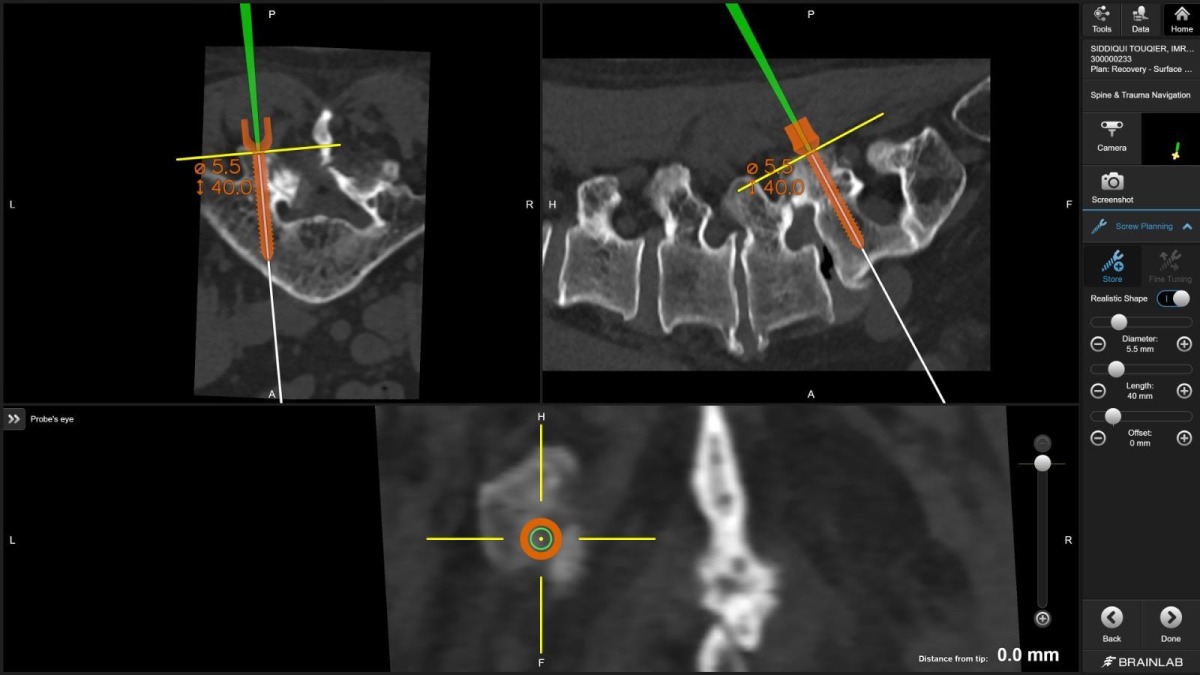
"The glasses showed me the patient's spine as if I could hold it in my hands," Dr. Belkhair describes. "I could see where every screw needed to go, what angle, what depth. It's surgical precision at a level we couldn't achieve even five years ago."
This is healthcare in Qatar today.
What This Means for Patients
For patients considering spine surgery at DOC Medical Center, the benefits of navigation technology are tangible:
Greater accuracy: Over 95% optimal screw positioning versus 80-85% with conventional techniques
Reduced radiation exposure: Less need for repeated intraoperative X-rays
Fewer complications: Lower rates of nerve injury, blood vessel damage, and implant malposition
Shorter recovery: Minimally invasive techniques mean smaller incisions, less pain, faster return to normal activities
Better long-term outcomes: Precisely placed implants are less likely to fail over time
For elderly patients, those with complex deformities, or individuals with previous failed surgeries, navigated approaches can mean the difference between surgical candidacy and inoperability. The technology expands what's possible.
Building Trust Through Transparency
Spine surgery is rarely an easy decision. Patients grapple with fear, of paralysis, chronic pain, losing independence.
When Dr. Belkhair sits with patients at DOC Medical Center to explain navigated surgery, he doesn't just describe technology. He describes certainty.
"I can show patients their own CT scans in three dimensions," he says. "I can explain exactly where the screws will go, why, and how the navigation system ensures precision. That transparency builds trust. Patients go into surgery knowing their surgeon has planned every detail."
That trust is therapeutic. Reduced preoperative anxiety correlates with better postoperative outcomes, improved pain management, and faster recovery.
"Machines assist. Humans heal," he says simply. "The technology serves the relationship between doctor and patient, it doesn't replace it."
DOC Medical Center: At the Forefront of Neurosciences in Qatar
Qatar's healthcare vision extends beyond world-class facilities. It aspires to regional leadership in medical innovation, research, and education. The National Health Strategy 2024-2030 emphasizes precision medicine and digital health integration, areas where DOC Medical Center excels.
Under Dr. Belkhair's neurosciences leadership, DOC Medical Center has invested in advanced navigation systems, trained multidisciplinary teams, and established protocols that prioritize both cutting-edge technology and compassionate patient care.
Patients from across the Gulf now have access to neurosurgical care that matches or exceeds what's available anywhere in the world, delivered right here in Qatar.
What This Means for You
If you or a loved one faces spinal pathology, degenerative disease, herniated discs, spinal stenosis, scoliosis, trauma, or tumor, DOC Medical Center offers world-class navigated surgical care.
Dr. Belkhair and his neurosciences team provide comprehensive evaluation, advanced imaging, multidisciplinary treatment planning, and access to the latest surgical technologies including navigation and virtual reality planning. The focus remains patient-centered: understanding your condition, exploring all treatment options, and when surgery is indicated, delivering it with the highest precision modern medicine allows.
The first navigated spine surgery in Qatar's private healthcare sector is not just a milestone for the surgical team, it's a milestone for every patient who will benefit from this technology in the years ahead.
REFERENCES
Qatar Ministry of Public Health - Clinical Guidelines for spine care standards
The Spine Journal - "Higher Accuracy and Better Clinical Outcomes in Navigated Spine Surgery" (October 2024)
NIH/PMC - "Virtual and Augmented Reality in Spine Surgery" (August 2023)
NIH/PMC - "Current State of Navigation in Spine Surgery"
The Peninsula Qatar - Dr. Belkhair's previous pioneering work at HMC (November 2023)
DISCLAIMER
Spine surgery is a major decision that requires careful evaluation by experienced specialists. If you're experiencing chronic back or neck pain, neurological symptoms, or have been diagnosed with spinal pathology, a comprehensive consultation can help determine the most appropriate treatment path for your individual condition.