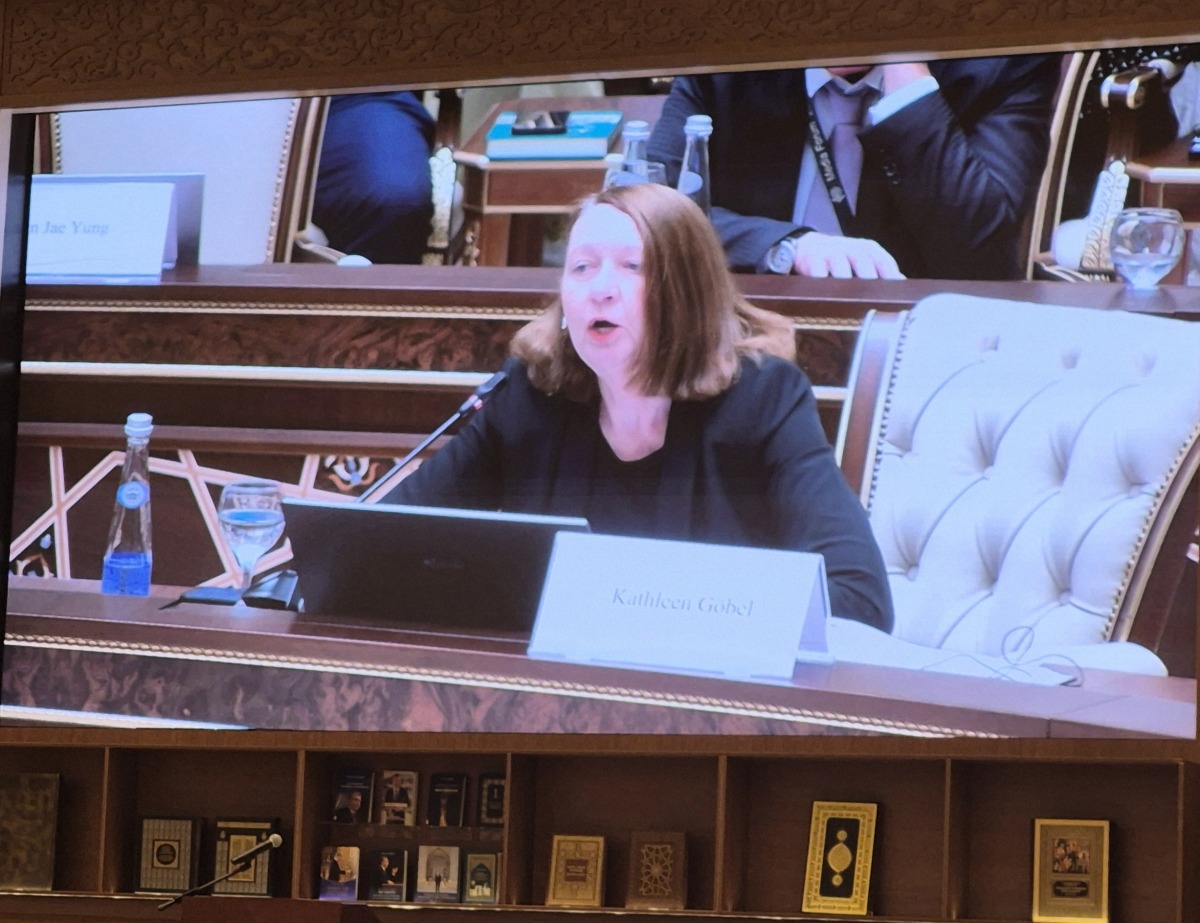
Tashkent: On the sidelines of the International Media Forum in Tashkent, The Peninsula had an opportunity to speak with Kathleen Gobel , Director of Cultural Cooperation at International Evolve of Germany and one of the speakers on the second day of the forum.
She discussed her book on the 99 Beautiful Names of Allah, plans to translate it into several languages, Uzbekistan’s efforts to promote the heritage of Islamic civilisation, and the importance of cultural dialogue. She also spoke about her collaboration with the Qatari Cultural Centre in Berlin.
Gobel said her participation in the forum provided an opportunity to present her book and engage with scholars and experts working on Islamic civilisation.
“I am here in Uzbekistan because I was invited to the major international media conference on subjects related to Islam, organised by the Centre of Islamic Civilisation. I was honoured to present my book at the main conference,” she said.
Currently available only in German, the book focuses on Al-Asma al-Husna, the 99 Beautiful Names of Allah. Gobel said that because Arabic religious terminology is less familiar to many German readers, the book is titled The Secret Name of God in German.
She explained that the title draws on a tradition that a person who masters the 99 names may come to know the 100th name - a name believed to “open many doors.”
The structure of her book reflects the 99 names, with one chapter dedicated to each name. Every chapter draws on a range of Islamic sources, including the Qur’an, Hadith, Sunnah and Sirah, alongside the writings and teachings of saints and philosophers from the past and present.
The book also incorporates poetry and humorous stories, including tales of Nasruddin Hoja, also known as Mullah Nasruddin.
“Religion does not always have to be serious. It can also contain joy and humour,” Gobel said.
She described the work as an attempt to bring authentic Islamic sources into conversation with modern Western modes of presentation without altering the substance of the original material.
“Not a single word of the original sources has been changed,” she said, comparing the approach to separating a container from its content. While the content remains unchanged, she explained, the “container” can be adapted to make the material more accessible to Western readers.
Gobel said this approach also corresponds with the Centre of Islamic Civilisation’s efforts to explore ways of presenting Islamic intellectual and cultural heritage to contemporary audiences.
Turning to plans to make the book available to a wider readership, Gobel said discussions are underway for translations into several languages.
A Russian translation is expected to be overseen by a prominent Russian Imam, while an Imam originally from Syria who has lived in the United States for many years is expected to supervise the English version.
An offer has also been received for a Turkish translation, while Uzbek and possibly Arabic versions are being considered.
Gobel said a small selection of chapters had already been translated on a trial basis in Uzbekistan and received positively by young readers.
“It is what they know, but it is like a breath of fresh air in a modern dress,” she said.
She said the translation initiative is being coordinated with the Centre of Islamic Civilisation, adding that the Centre is willing to cooperate on projects that meet appropriate professional standards. Gobel stressed that translating a work dealing with the 99 Beautiful Names requires particular care because religious terminology is highly contextual. Her preference is for translations to remain as close as possible to the original wording while still reading naturally and fluently in the target language.
“If there is a choice, it should be as close to a word-for-word translation as possible, while still being fluent in the language of the country,” she said.
This is particularly important because the book draws from different traditions and perspectives. Gobel described the work as a “kaleidoscope” in which different interpretations and sources exist under a common umbrella.
She cautioned against adjusting every passage to conform to a single school of interpretation, arguing that apparent differences should sometimes be preserved because they reflect distinct perspectives and traditions.
For Qur’anic verses used in the book, Gobel said she examined several translations before choosing the English translation by Abdullah Yusuf Ali, particularly its older edition, as a reference. The verses are accompanied by interpretations from different scholars and spiritual authorities, an approach she hopes will be maintained in future translations.
Knowledge as a response to Islamophobia
Discussing Uzbekistan’s emphasis on preserving, translating and presenting the heritage of Islamic civilisation, Gobel said education and knowledge are among the most effective ways of confronting fear, Islamophobia and misconceptions about Islam.
“The best tool against fear, Islamophobia and misconceptions born out of fear is education and knowledge,” she said.
She pointed to the Centre of Islamic Civilisation as an example of this approach, saying its scale and presentation can attract even visitors who initially have little knowledge of or interest in Islamic history and culture. By drawing people in and encouraging them to explore, she said, such institutions can contribute to a better understanding of Islam and its core values.
“Through that process, they may come to understand that Islam, in its core meaning, is peaceful,” Gobel said.
She compared religion to a hammer, arguing that the same tool can be used constructively or destructively depending on the person using it.
“You can take a hammer and use it to put a nail into a wall so that you can hang a beautiful picture. You can also take the same hammer and hit somebody over the head,” she said.
The issue, she added, is therefore not the tool itself but how human beings choose to use it. The principle applies not only to Islam but to religions more broadly.
For Gobel, religion and culture are deeply interconnected, while civilisation depends on peace, honesty and responsible engagement between people and traditions.
Cultural dialogue and Qatar
Kathleen Gobel also highlighted her collaboration with the Qatari Cultural Centre in Berlin, saying its activities place a strong emphasis on culture and dialogue rather than focusing narrowly on religion.
She described the Centre’s premises as a historic and elegant building in Berlin that once served as a meeting place for journalists, writers and other cultural figures and was restored in recent years.
While some activities have been affected by the current international situation, Gobel said the Centre continues to organise cultural initiatives aimed at bringing together people from different countries and backgrounds.
In April, she participated in an international children’s book event that brought together authors and publishers presenting stories from different countries in German, English and their original languages.
Another major international book event for adults is planned for October, with books representing different countries, cultures and civilisations.
“These are examples of their efforts to create dialogue and importantly, open dialogue,” Gobel said.
She recalled that during the children’s event, activities were organised around the stories of Nasruddin Hoja, or Mullah Nasruddin. A young Uzbek participant dressed as the famous character; an experience she said delighted the children.
“That is dialogue in practice,” she said.
Gobel stressed that the book initiatives are not intended to focus exclusively on German publications. Rather, the objective is to bring together international books representing the civilisation and culture of different countries, irrespective of the language in which they are published.