Doha, Qatar: Qatar’s leadership is determined to remain actively engaged in efforts to resolve regional conflicts, with mediation forming a key pillar of the country’s foreign policy, despite the challenges and attacks it has faced, said Prime Minister and Minister of Foreign Affairs H E Sheikh Mohammed bin Abdulrahman bin Jassim Al Thani.
“The (Qatar’s) leadership is determined that we cannot be just sitting silent without trying our best to make sure that we get the best for our region and for our country,” the Prime Minister said in an interview with British broadcaster Piers Morgan on ‘Piers Morgan Uncensored’, went online yesterday.
He said Qatar’s mediation role had been developed over years and had become deeply embedded in the country’s institutions and foreign policy.
“We have had a track record in agreements, whether it was between Eritrea and Djibouti, Sudan, which was way before we came even into politics or government myself personally, and then of course you have seen Afghanistan-US mediation, Gaza mediation and Iran-US mediation,” he said.
“There are many fronts where we have developed and cultivated this skill within our institutions and our people to become a key theme of Qatar’s foreign policy.”
The Prime Minister said Qatar’s commitment to mediation had continued even when the country itself came under attack during the recent conflict.
He described the Israeli attack on Qatar while Doha was mediating and working to advance a proposal by US President H E Donald Trump as “totally unacceptable and condemned”.
“It is setting a precedent of attacking the mediator that has never happened throughout the wars in history. Mediators have always had a special status within different adversaries,” he said. “Yet Netanyahu has crossed the line, like he has crossed other lines before that.”
He also condemned the attack on Qatar by Iran, stressing that Doha had worked consistently to prevent the conflict. “When we were attacked from Iran, it was also totally unacceptable to be attacked, not only as a mediator but as a neighbour that didn’t cause harm for them."
“It was the opposite, actually. We were trying to help to avoid this war for them all the time,” he said.
The Prime Minister said the attacks initially created a difficult situation for Qatar’s mediation efforts, with the country receiving numerous calls from world leaders urging it to step forward and help.
“H H the Amir has a vision that if we are preserving one single life, if we are preserving a city from being attacked or a group of civilians to be protected, that’s worth all what’s happening. Basically, this is what we are trying to do,” he said.
He said the region had enormous potential despite the conflicts affecting it. “Our region has a lot of potential. It’s unfortunate that we are living under these complications. It’s blessed with resources. We have talented people. There are smart people all around the region,” he said.
“If this region comes together, it will be way more powerful than any part of the world. And this is something that all of us should aspire for.”
Addressing the economic repercussions of the conflict, H E Sheikh Mohammed said Qatar was facing difficulties, including a budget deficit, but stressed that the country’s institutions had demonstrated significant resilience.
“The sustainability of our institutions and the response that they had showed an outstanding response, whether it’s from a defence point of view or from a supply chain point of view,” he said.
He said Qatar’s financial preparedness, including the establishment of its sovereign wealth fund more than two decades ago and the creation of stability funds, had helped the country navigate the current circumstances.
“Yes, we are facing difficulties and a deficit. But if we hadn’t built our reserves, created our sovereign wealth fund, which was a decision that was taken more than 20 years ago, and the stability funds that we created a few years ago for the government that keeps the government up and running, even with our budget cuts that we have done, we have done this very wisely and very clearly on certain secondary projects, not in our capital projects, nor in our payroll and the salaries of the people,” he said. “We did not, and we don’t want, the people to feel affected as much as possible.”
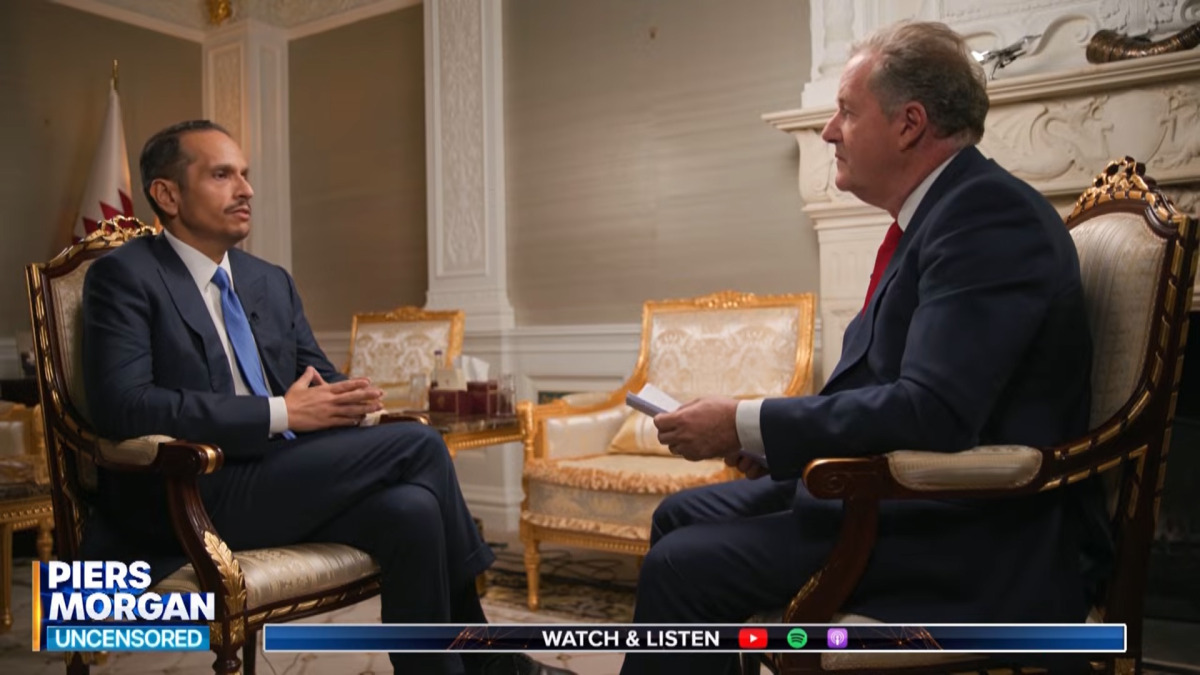
The Prime Minister said the economic challenges were circumstantial rather than structural and that Qatar remained committed to expanding its LNG production. “It’s not a structural contraction for our economy,” he said.
“We are still pursuing our expansion of the LNG. Our production will come back online as soon as those trains are fixed, and once the shipping is resumed, we are going to recover for all our customers what has been missed.”
Replying to another question, H E Sheikh Mohammed rejected criticism from Israeli Prime Minister Benjamin Netanyahu over Qatar’s relationships with American universities and its alleged influence on public opinion.
“When Netanyahu came out and attacked Qatar, he’s just trying to gaslight the public,” he said, arguing that criticism of Qatar was being used to divert attention from opposition to Israel’s actions in Gaza.
“Accusing Qatar of funding universities, funding journalists, funding everyone who goes against Israel is totally false,” he said. He said Qatar’s engagement with American universities was primarily connected to campuses operating in Qatar and providing educational opportunities in the region.
“When we are funding universities, we are not funding people or students or influencing the content of these universities. We are funding universities that operate in Qatar and have campuses there and offering the opportunity and the chance for people in the region to study in these campuses,” he said.
He pointed to institutions including Weill Cornell, Carnegie Mellon, Texas A&M, Virginia Commonwealth and Georgetown, saying the majority of Qatar’s spending on these institutions was related to their campuses and operations in the country.
“It is not to influence the curriculum. Anyone can come and ask the universities, their campuses and the professors if the government is interfering in anything related to the academia of these universities,” he said.
H E Sheikh Mohammed also rejected allegations that Qatar was using its relationships with universities or lobbying to influence US policy. “These kinds of false accusations about Qatar and using Qatar as a scapegoat to justify war crimes, to justify students going against the war in Gaza, is just trying to play the blame game,” he said.
In reply to a question about the war in Gaza, Prime Minister condemned the October 7, 2023 attack while also strongly criticising Israel’s subsequent military campaign. “There is no question that October 7 was a massacre and should be condemned, and whoever is responsible for this should be held accountable,” he said.
“But when we look at the response to October 7, 70,000 people being killed, a whole city, a tiny city, being wiped out, hospitals being targeted, schools being targeted, whatever the justifications and the arguments, nothing is justifying this.”
The Prime Minister said Qatar had repeatedly sought to facilitate ceasefires and secure the release of civilian hostages, but claimed that its efforts had been undermined. “We were coming very directly to the Israeli officials and telling them that we got an agreement on releasing all the civilian hostages. Just give a window of a ceasefire to get everyone out, and they even rejected to entertain the idea,” he said.
“That’s showing what their interest is, is it saving their people or just going there?”
Morgan asked what advice the Prime Minister would give President Trump as efforts continue to address the regional conflict, he said Qatar had found the US President receptive to diplomacy.
“In every time His Highness the Amir or myself have a conversation with President Trump, he has been always listening. He has been always very responsive and very positively engaged,” he said.
“Whenever we have a real chance for diplomacy, he always gives this chance and gives this opportunity, and I really commend this in him. I hope that this time our efforts work.” The Prime Minister said the moment was particularly important for Qatar, the region, the United States and the wider international community.
“I think that it’s timely. It’s timely for us. It’s timely for the region. It’s timely for America and the world,” he said. “I believe there is no better thing than being the President who led to peace in the region, as he did in leading to the ending of the war on Gaza.”