Doha, Qatar: Fifteen undergraduate student researchers from Northwestern University in Qatar have been selected to join the Institute for Advanced Study in the Global South (#IAS_NUQ) as part of the 2026 cohort of its flagship Global Undergraduate Fellowship program.
The year-long fellowship is designed to cultivate advanced, independent scholarship focused on the Global South. Throughout the program, fellows receive intensive mentorship from faculty and #IAS_NUQ staff, participate in specialized training and workshops, and engage in #IAS_NUQ programs and events while developing original research projects on topics of their choosing.
The fellowship supports a wide range of outputs, including academic research papers, creative multimodal projects, and short documentaries. Their final projects will be published by #IAS_NUQ_Press and showcased to the Northwestern Qatar and Education City community at the annual #IAS_NUQ Global Undergraduate Fellow Presentations held each year at the end of January.
“Year after year, the Global Undergraduate Fellowship continues to offer our students the opportunity to advance new or ongoing research and creative projects to develop them into an original contribution to evidence-based storytelling and hence to knowledge,” said Marwan M. Kraidy, dean and CEO of Northwestern Qatar.
“What stands out is the scholarly excellence of each cohort and the collaborative spirit that defines the fellowship: students working closely with faculty, mentors, and communities to ask difficult questions and produce work that matters. We continue to see graduates carry this experience forward into research, creative practice, and public engagement across the region and beyond. “
The 2026 cohort was selected through a highly competitive application process. In close collaboration with faculty mentors, fellows will examine complex political, cultural, and social dynamics across the Middle East, Africa, and Central, South, and Southeast Asia. This year’s projects address a wide range of critical themes, including digital protest cultures in Nepal, the relationship between church and state in Armenia, the effects of political incarceration on families in the West Bank, the preservation of minority languages and identities across Mongolia, China, and Kazakhstan, and a sound-driven documentary in Qatar that examines Islamic life through sensory and sonic practices.
Several projects in the 2026 cohort are rooted in deeply personal, place-based inquiries that combine lived experience with rigorous research. Third-year journalism student Alexandr Khalatyan is developing an interactive website that examines the mediated memory of Artsakh following the forced displacement of its population.
Drawing on his firsthand experience, the project explores how collective memory is shaped in the aftermath of territorial rupture. “Witnessing the exodus myself, I can’t help but wonder how this major rupture will affect the memory of a suddenly lost country, particularly through various media practices,” said Khalatyan.
Another fellow selected for the fellowship is Nomin Erdenetsogt, who is producing a video-based project that explores Mongolian script and language politics across the Mongolia–Inner Mongolia border.
“I grew up going back and forth between Mongolia and Inner Mongolia, and from a young age, I noticed how a shared language and culture can take on very different meanings once borders intervene. As someone who practiced Mongolian script calligraphy, I’ve always felt closely connected to the script. Seeing it ineffectively revived in Mongolia while being restricted in Inner Mongolia made me want to understand what it means to the people who live with these realities every day,” said Erdenetsogt. “Through this project, I want to introduce audiences to this 800-year-old script while bringing together voices from both sides of the border to reflect on identity, memory, and what it means to fight for a language.”
Third-year student Tayama Rai is pursuing a research paper analyzing the role of instant messaging and VoIP social platform Discord in Nepal’s 2025 Gen Z protest movement. Her project investigates how a platform commonly associated with gaming became a key space for political deliberation, consensus-building, and youth-led mobilization.
“This project began when I realized that young people in Nepal were debating the country’s political future on Discord, a platform widely known as a gaming space, during the 2025 Gen Z protest. Long excluded from formal politics, Nepali Gen Z used this space to deliberate, build consensus, and influence real political outcomes. My research looks at what this moment reveals about youth agency and digital activism in the Global South, all while connecting lived experience to broader questions about digital politics,” said Rai.
The projects developed by the 2026 cohort speak to the Institute’s commitment to evidence-based storytelling that is multilingual, multimodal, and grounded in place. By supporting research that spans languages, formats, and geographies, the Global Undergraduate Fellowship program positions undergraduate scholars as critical producers of knowledge at the intersection of research, media, and public engagement.
“The Global Undergraduate Fellowship is a central pillar of knowledge production at #IAS_NUQ. With projects that include research papers on meme cultures in Kazakhstan, Amharic epistemologies, multimodal projects on humor in contemporary Lebanon, literary cultures in colonial Vietnam, or documentary films on a forgotten nuclear city in Kazakhstan, a radio station in East Timor, or Arabic education in Northwest China, to name just a few, the 2026 cohort, our fifth cohort, demonstrates the breadth, depth, and multiplicity of forms evidence-based storytelling from the Global South can take. We look forward to working with the new fellows and their faculty mentors over the next year,” said Clovis Bergère, director of #IAS_NUQ.
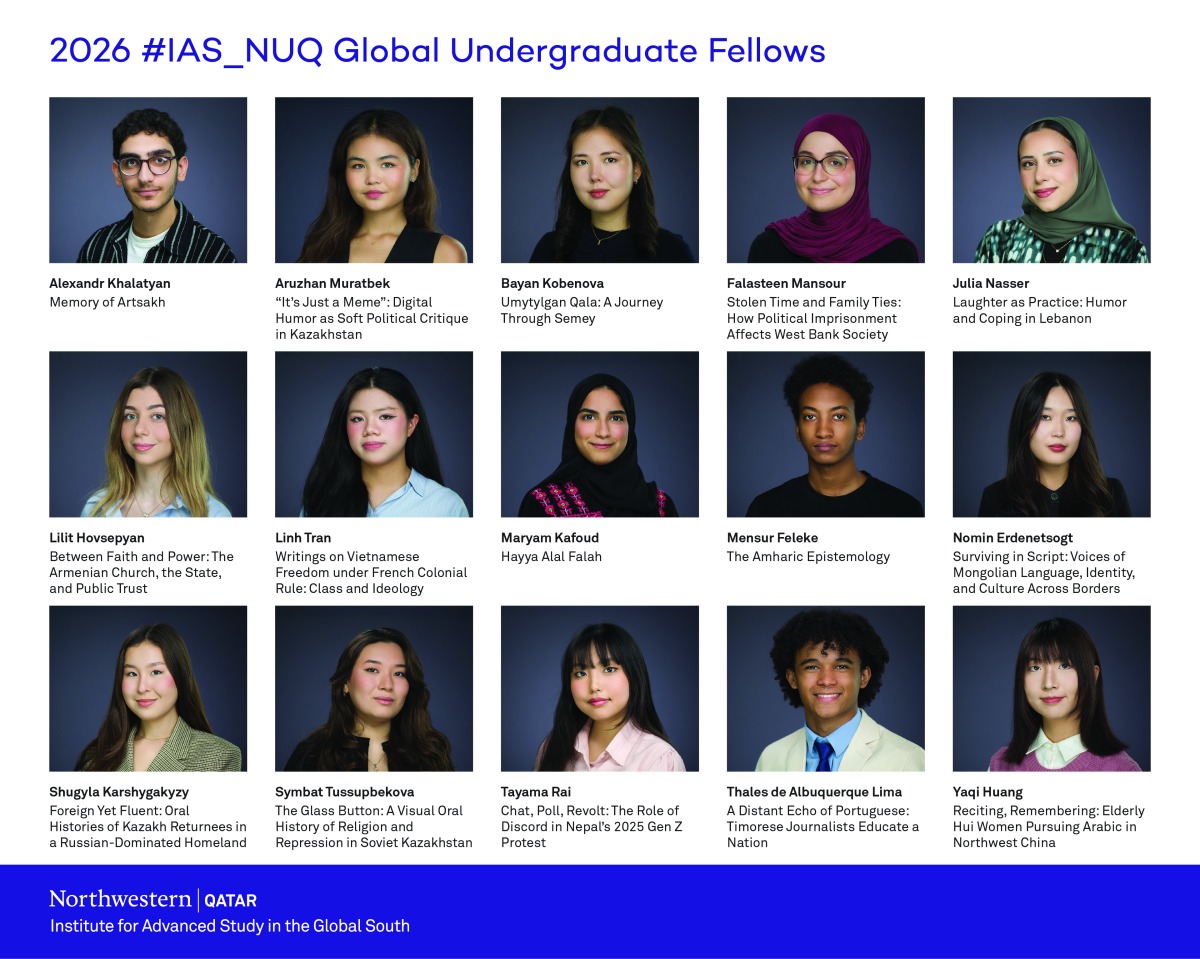
2026 #IAS_NUQ Global Undergraduate Fellows and their research topics:
Alexandr Khalatyan – Memory of Artsakh
Aruzhan Muratbek – “It’s Just a Meme”: Digital Humor as Soft Political Critique in Kazakhstan
Bayan Kobenova – Umytylgan Qala: A Journey Through Semey
Falasteen Mansour – Stolen Time and Family Ties: How Political Imprisonment Affects West Bank Society
Julia Nasser – Laughter as Practice: Humor and Coping in Lebanon
Lilit Hovsepyan – Between Faith and Power: The Armenian Church, the State, and Public Trust
Linh Tran – Writings on Vietnamese Freedom under French Colonial Rule: Class and Ideology
Maryam Kafoud – Hayya Alal Falah
Mensur Feleke – The Amharic Epistemology
Nomin Erdenetsogt – Surviving in Script: Voices of Mongolian Language, Identity, and Culture Across Borders
Shugyla Karshygakyzy – Foreign Yet Fluent: Oral Histories of Kazakh Returnees in a Russian-Dominated Homeland
Symbat Tussupbekova – The Glass Button: A Visual Oral History of Religion and Repression in Soviet Kazakhstan
Tayama Rai – Chat, Poll, Revolt: The Role of Discord in Nepal’s 2025 Gen Z Protest
Thales de Albuquerque Lima – A Distant Echo of Portuguese: Timorese Journalists Educate a Nation
Yaqi Huang – Reciting, Remembering: Elderly Hui Women Pursuing Arabic in Northwest China